

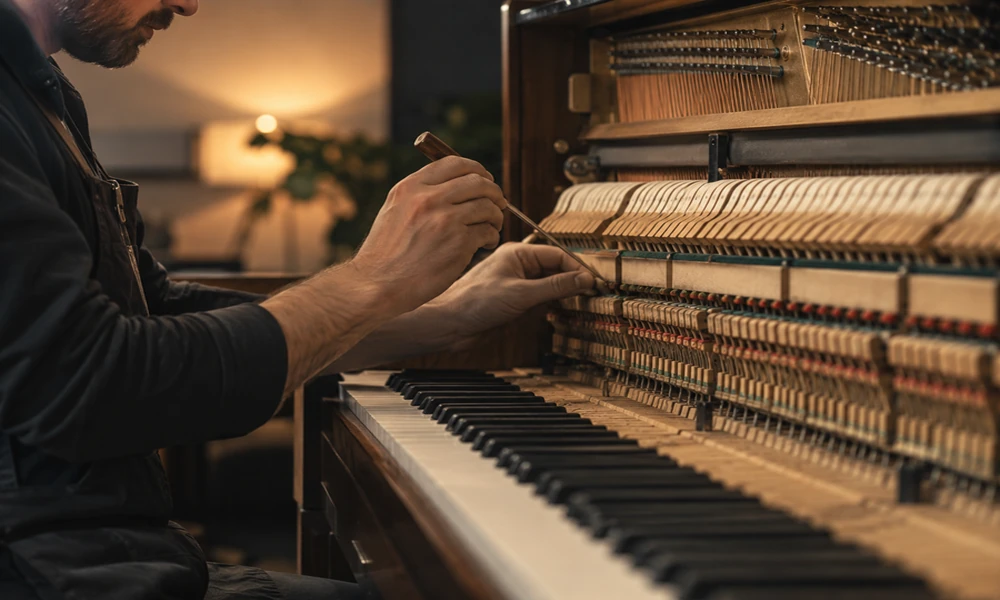
Regular tuning is an important part of piano care, but pitch is only one part of how an acoustic piano performs. An older instrument can be brought into tune while still suffering from uneven touch, worn mechanical components, tonal inconsistencies, structural problems, or deteriorating finishes.
For owners of older pianos, the challenge is knowing when routine maintenance is enough and when the instrument deserves a more comprehensive evaluation. Several warning signs can help make that distinction.
1. The Piano Is in Tune but Still Doesn’t Sound Right
Tuning primarily addresses pitch. It cannot resolve every issue affecting the character or consistency of a piano’s tone.
For example, the condition and adjustment of the hammers can influence how evenly notes respond across the keyboard. Strings and other components may also deteriorate with age. As a result, an instrument may be technically tuned while some notes still sound noticeably different from neighboring notes.
That does not automatically mean the piano needs to be rebuilt. It does suggest that the owner should look beyond pitch and consider whether voicing, regulation, component wear, or a combination of issues is affecting the instrument.
2. The Keyboard Feels Uneven or Unresponsive
A piano’s action contains the mechanical system responsible for translating a key press into a hammer striking a string. When that system is properly adjusted, the keyboard should respond predictably enough for the player to control dynamics and repetition.
Older instruments can develop problems such as uneven key height, inconsistent resistance, sluggish response, or difficulty repeating notes cleanly. Some of these concerns may be addressed through regulation or targeted repairs rather than a complete restoration.
What matters is identifying the cause before choosing the solution. Repeatedly tuning an instrument will not correct mechanical problems in the action, just as refinishing a cabinet will not improve an uneven keyboard.
3. Several Different Problems Are Appearing at Once
One isolated issue often calls for an isolated repair. A collection of problems deserves a broader look.
Consider an older piano that has uneven keys, inconsistent tone, visible cabinet deterioration, and difficulty maintaining stable performance. Treating each symptom independently may overlook how the instrument’s overall age and condition are contributing to the situation.
This is where a comprehensive assessment becomes useful. Owners trying to understand the difference between routine repair and deeper restoration can review the scope typically covered by Piano Restoration Services on Long Island, including mechanical, structural, tonal, and cosmetic work. The useful question is not simply whether the piano is “old,” but which systems actually need attention and how those priorities relate to one another.
A good evaluation should make room for partial restoration as well. Not every instrument needs every available procedure at the same time.
4. Tuning Stability Has Become a Recurring Concern
An occasional tuning adjustment is normal maintenance. Persistent instability deserves more investigation.
A piano depends on more than the strings themselves to maintain reliable performance. Components associated with string tension and structural stability also matter. When an instrument repeatedly struggles to remain stable, simply scheduling increasingly frequent tuning appointments may address the symptom without explaining the underlying condition.
A technician can examine the piano more broadly and determine whether the problem is limited or connected to components that require repair or restoration.
This distinction is especially important for an instrument that has been unused for a long period or has an uncertain maintenance history. The goal should be to understand its present condition before deciding how much work is justified.
5. Visible Wear Is Accompanied by Performance Problems
Cosmetic wear alone does not necessarily affect how a piano plays. Scratches, fading, worn hardware, or aging finish can be primarily aesthetic concerns.
The situation changes when visible deterioration appears alongside mechanical or tonal problems.
For instance, an owner may initially be interested in refinishing an older cabinet because the instrument is an important piece of furniture in the home. If the keyboard, action, tone, or structural components also need attention, it makes sense to assess those needs before focusing exclusively on appearance.
Restoration planning works best when cosmetic goals are considered alongside musical and mechanical priorities rather than treated as an unrelated project.
6. The Piano Has Significant Personal Value
Market value is not the only reason an older piano may deserve careful evaluation.
Some instruments have been passed through families, used for decades of lessons, or associated with important memories. In those situations, the decision is not simply whether restoration would increase the piano’s resale price.
Instead, owners may want to know whether the instrument can become reliable and enjoyable to play again while preserving as much of its original character as practical.
A professional assessment can help establish realistic priorities. Depending on condition, targeted mechanical work may be sufficient, while another instrument may require more extensive attention to achieve the owner’s goals.
7. You Are Unsure Whether to Repair, Restore, or Leave It Alone
Uncertainty itself is a good reason to begin with an evaluation rather than a predetermined solution.
A professional inspection can separate cosmetic concerns from mechanical and structural ones and identify which work is essential, optional, or unnecessary. That information gives owners a clearer basis for deciding how much they want to invest in the instrument.
It can also prevent two opposite mistakes: undertaking extensive work that the piano does not need or postponing an underlying problem because it appears to be a simple tuning issue.
Conclusion
An older piano does not need a full restoration simply because it shows its age. Many instruments benefit from targeted repairs, regulation, voicing, or other focused attention.
The strongest reason to consider a deeper evaluation is the presence of problems that routine tuning cannot explain or correct-particularly when mechanical, tonal, structural, and cosmetic concerns begin appearing together.
Understanding those distinctions allows piano owners to make decisions based on the actual condition of the instrument rather than its age alone. Whether the eventual answer is maintenance, selective repair, partial restoration, or more extensive work, a careful assessment is the most useful place to begin.